Lymph Savior Official Website › Articles › Label literacy
Label literacyTwo Lymph Savior Graphics, Two Different Ingredient Lists
Two vendor graphics claim to show what is inside Lymph Savior, and they do not agree with each other.
One names red root and centella asiatica. The other, simpler graphic drops both and substitutes ginger root and echinacea instead. No Supplement Facts panel exists anywhere to settle which one is right, which makes this less a question about one ingredient and more a question about what a marketing graphic can and cannot tell a buyer.
Lymph Savior is a dietary supplement, not a treatment. Nothing here is medical advice. Anyone for whom a specific plant is a real medical constraint should confirm the full ingredient list with the manufacturer directly rather than from any marketing graphic, including the ones printed by this website.
Three documents, and only two of them agree
Three separate documents describe what is supposedly inside a bottle of Lymph Savior, and they were not all made for the same purpose. The first is the seller's own written ingredient list, the plain text version used on the sales page. The second is a detailed vendor graphic headed INSIDE LYMPH SAVIOR, built for the product page, with a labelled illustration of the bottle. The third is a second, simpler graphic headed WHAT IS INSIDE, built as a circular icon layout, apparently for a different part of the same sales funnel.
The seller's written list and the detailed INSIDE LYMPH SAVIOR graphic agree with each other completely: six plants, in the same order, described in the same terms. Red clover, horse chestnut, red root, centella asiatica, burdock and yerba mate. This website's ingredients page prints that six-plant list because two independent documents, built for two different purposes, happen to say the same thing.
The third document, the circle graphic, does not agree with either of the other two. It keeps four of the six names: red clover, horse chestnut, burdock and yerba mate. In place of red root and centella asiatica, it names ginger root and echinacea.
It is worth being precise about how this website treats each of the three. The written list and the detailed graphic are read as text, name by name, against each other first; only once they are confirmed to match does either get treated as the working list. The circle graphic is then checked against that working list separately, which is the step that surfaces the two substitutions. That sequence, confirm agreement first and only then compare the outlier, is a plainer way of saying what the ingredients page states in a single sentence: two sources are followed because they agree with each other, not because either one is self-evidently more official than the third.
The detailed graphic: INSIDE LYMPH SAVIOR
The INSIDE LYMPH SAVIOR graphic is built around an illustration of the capsule bottle with the six plant names arranged beside it, each with a small botanical icon. It names, in order: Red Clover Extract, Horse Chestnut Extract, Red Root Powder, Centella asiatica Extract, Burdock Powder and Yerba Mate Extract, and it gives the part of the plant used for each. It does not give an amount for any of them; no milligram figure, no percentage, no serving breakdown appears anywhere on the artwork.
This is the graphic this website treats as authoritative, for the specific reason that it carries the more detailed and more specific information, and because it says the same thing as the seller's separate written list, produced independently for a different part of the sales page.
The simpler graphic: WHAT IS INSIDE
The second graphic is a plainer layout: six circles arranged around a bottle icon, each circle holding one plant's common name with no Latin binomial and no part-of-plant detail. It appears to be a simplified, more shareable version of the same idea, built for a different placement in the marketing material, perhaps a social or carousel slide rather than the main product page.
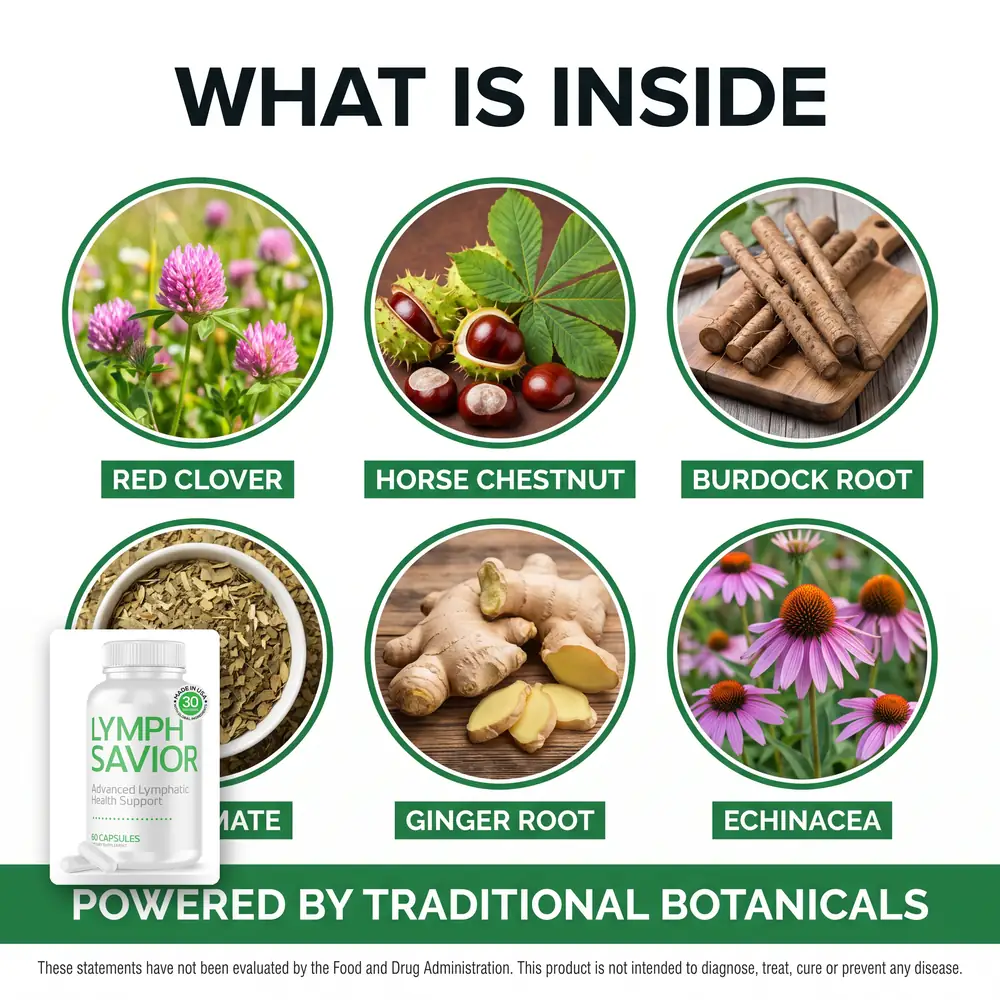
Whoever built this version either worked from an earlier or later formulation note, or simply made an error transcribing six names into six circles. Nothing in the material available to this website says which. What is certain is that the two graphics disagree, and that disagreement has sat unresolved on the seller's own marketing output for as long as this website has been tracking it.
The two graphics, side by side
| Named on the seller's written list and the detailed graphic | Also on the circle graphic? |
|---|---|
| Red Clover Extract | Yes |
| Horse Chestnut Extract | Yes |
| Red Root Powder | No — absent; ginger root appears instead |
| Centella asiatica Extract | No — absent; echinacea appears instead |
| Burdock Powder | Yes |
| Yerba Mate Extract | Yes |
Four of six names survive unchanged across both graphics. The two that do not are swapped for two different plants entirely, not simply dropped.
What would actually settle this
A Supplement Facts panel, the standardised back-of-bottle label the FDA's own guidance describes, would settle the question in one photograph. It would print a serving size, an amount for each botanical or blend, and an other-ingredients line naming the capsule shell (FDA supplement labeling guide). Neither graphic is that panel. Neither is a government filing, a certificate of analysis, or any other regulated document. Both are marketing artwork, built to be attractive and legible at a glance, and nothing obliges one piece of marketing graphic to be internally consistent with another piece of marketing graphic from the same seller.
No render the manufacturer has supplied to this website shows the actual back-of-bottle panel. Until one does, there is no regulated document available anywhere in this chain to arbitrate between the two graphics, and a reader is left weighing two pieces of artwork against each other rather than checking either against a label.
Why the substitution is not a trivial one
If the circle graphic's version were correct, two things about the formula would be different in ways that matter to a specific reader, not to everybody.
- Echinacea is itself a member of the Asteraceae family, the same family burdock already belongs to, alongside ragweed, chamomile and chrysanthemum. This website's side-effects page already flags Asteraceae sensitivity as a real consideration because of burdock; a second Asteraceae plant in the formula would be relevant to the same group of people.
- Ginger is taken seriously alongside anticoagulant medication. It would sit beside red clover's own coumarins as a second plant worth raising with a prescriber before combining with a blood thinner.
- Conversely, if the detailed graphic and written list are correct, as this website treats them, then red root carries no modern clinical literature at all, and centella asiatica carries two published liver-injury case reports, both covered elsewhere on this website. A reader avoiding either of those for a specific reason needs to know they are actually in the capsule.
- A manufacturer who intends to make a structure/function claim for a product is required to hold substantiation that the claim is accurate, under the same federal framework covered in a related article on this website. Two disagreeing graphics from the same seller do not, by themselves, prove the substantiation is missing, but they are not a confidence-building sign that the underlying formula record is tightly controlled either.
Lymph Savior, with the disagreement printed rather than hidden
Two vendor graphics, one written list, and a website that prints the disagreement between them rather than picking whichever one reads better.
One bottle $79 · three bottles $207 · 60-day money-back guarantee
Order Lymph Savior On The Official Website60 capsules a bottle · lot LYM-26/LY-1430 · ships from the U.S.
How two graphics from the same seller end up disagreeing
This website cannot say with certainty why the two graphics disagree, because nothing in the material supplied names a reason. What can be said is how this kind of inconsistency typically arises in multi-asset marketing campaigns generally: a detailed product-page graphic and a simplified social or carousel graphic are often built by different people, at different times, sometimes months apart, and a formulation change, a design refresh, or a simple transcription slip between the two is enough to produce exactly this pattern. None of those explanations is confirmed here. All of them are more mundane than either a buyer's worst fear or a seller's best defence would suggest, which is itself a reason not to over-read the disagreement in either direction.
How this website decided which list to print
This website follows the two sources that agree with each other and carry the more specific information: the seller's written list and the detailed INSIDE LYMPH SAVIOR graphic. That is a defensible rule, and it is still a rule applied to two pieces of marketing material rather than to a regulated document, which is a weaker foundation than a Supplement Facts panel would be.
The simpler circle graphic is treated as artwork rather than as a second, equally valid source. The ingredients page states this plainly, names both graphics, and does not pretend the disagreement does not exist. That is the standard this website tries to hold itself to across every page: where two sources disagree, both are named and the method for choosing between them is stated, rather than the more convenient one being quietly selected.
An alternative rule would have been to print whichever list looked more flattering, dropping the plant with no clinical literature and the plant with published liver-injury reports in favour of a shorter, cleaner-sounding story. That was not the rule applied here. A reader who only wanted to hear good news about this formula would, if anything, have been better served by the circle graphic's version; this website printed the version supported by the stronger documentation instead, even though it is also the version that raises more questions on the safety and evidence pages elsewhere on this website.
What a reader should do with two disagreeing graphics
- Treat the detailed INSIDE LYMPH SAVIOR graphic and the seller's written list as the working ingredient list, because they agree and carry more specific information.
- Treat the circle graphic as unreliable artwork rather than as a second confirmed source, until the manufacturer resolves the discrepancy.
- If a reaction to ginger, echinacea, red root or centella asiatica is a real medical constraint, do not resolve it from either graphic. Put the question to the manufacturer directly, in writing, before ordering.
- Ask for a photograph of the actual Supplement Facts panel before assuming either version of the ingredient list is complete. This website's contact page takes that question and prints the answer on the ingredients page when one arrives.
- Generalise the lesson past this one bottle: a product photograph or a social-media graphic is marketing art, not a label, and the two are not interchangeable even when a seller presents them as though they were.
This article is deliberately about the method rather than about one plant. The ingredients page covers what each of the six named botanicals was studied at, and a separate article covers the amounts problem in detail.
- U.S. Food and Drug Administration. Dietary Supplement Labeling Guide. https://www.fda.gov/food/dietary-supplements-guidance-documents-regulatory-information/dietary-supplement-labeling-guide