Lymph Savior Official Website › Articles › Ingredient deep dive
Ingredient deep diveBurdock's Three Human Trials: A Tea, An Exercise Study, And None Of Them About Lymph
Burdock Powder is the fifth name on the Lymph Savior label, and three human trials exist for the root. None of them measured anything about lymphatic drainage.
A tea in knee osteoarthritis, an exercise programme in elderly women, and a 2026 trial in polycystic ovary syndrome. Two used a hot-water infusion rather than the encapsulated powder actually sold here, and the one trial that did use root powder was testing ovarian volume, not swelling.
Lymph Savior is a dietary supplement, not a treatment. Nothing here is medical advice. Swelling that is new, on one side only, painful, hot or spreading needs assessment the same day rather than a purchase, and the NHS page on lymphoedema sets out what is worth reporting.
Burdock on this label
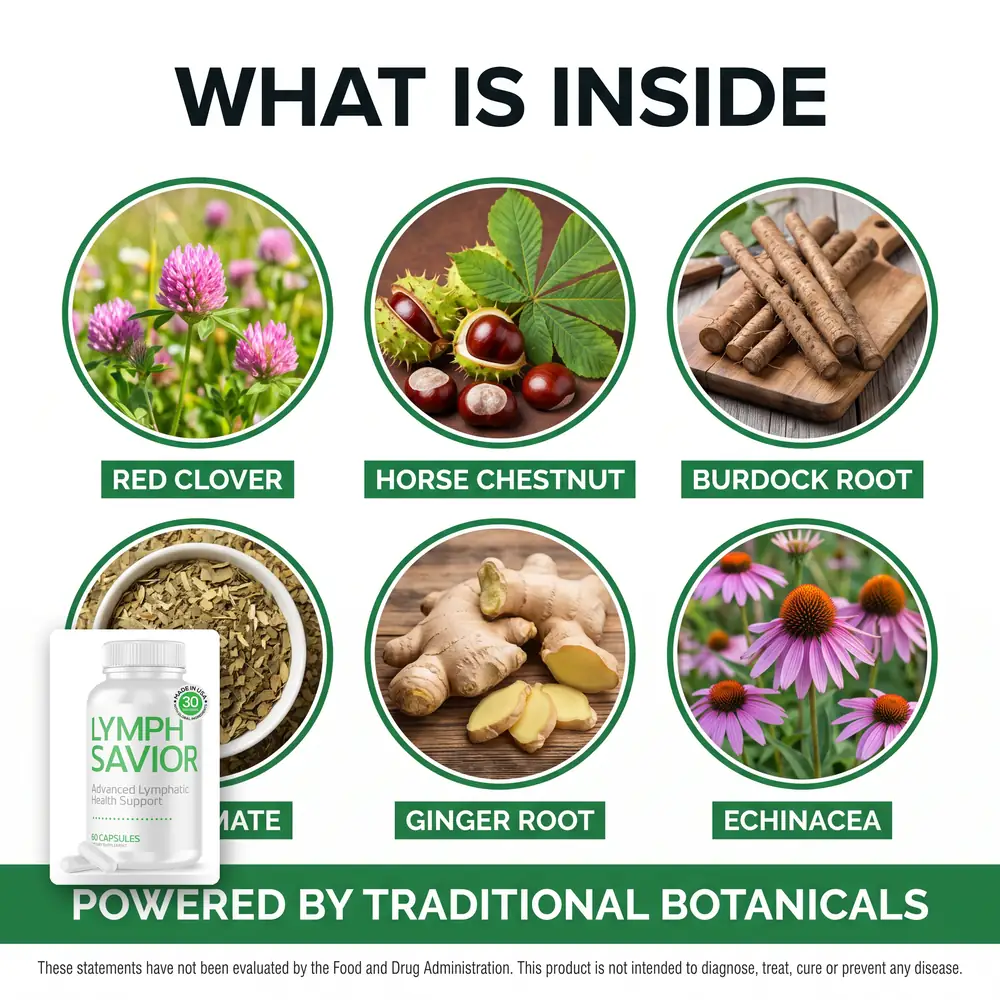
Burdock Powder, from the root of Arctium lappa, is the fifth of six botanicals named on Lymph Savior. The ingredients page lists it alongside red clover, horse chestnut seed, red root, centella asiatica and yerba mate, with no amount printed for any of the six. Burdock is also one of the four names the second vendor graphic keeps; the circle tile drops red root and centella asiatica but it keeps burdock, alongside red clover and horse chestnut.
Gobo, as it is known in Japan, is a large biennial root vegetable eaten as a food as often as it is taken as a supplement, and it has a long history as an alterative in both Western and Chinese herbal traditions: a plant taken to gradually improve general health rather than for one specific complaint. That broad traditional reputation is a reasonable account of why it is on a six-plant lymphatic formula. It is a separate question from what the clinical literature on the plant actually says, and that is the question this article answers.
Searching the National Library of Medicine for Arctium lappa alongside clinical and randomised keywords returns a short, specific list: three human trials, published in 2016, 2018 and 2026. Every one of the three is read out in full below, because a label that names a plant without naming an amount leaves the trials as the only concrete thing a reader has to go on.
Trial one: a tea, in knee osteoarthritis
The earliest of the three is a randomised trial of thirty-six people, ten men and twenty-six women, aged 50 to 70, with knee osteoarthritis, treated at the Physical Medicine and Rehabilitation department of Tabriz University of Medical Sciences in Iran (Maghsoumi-Norouzabad, 2016).
Every participant, in both arms, received the same standard analgesia for the 42 days of the study: two 500 mg doses of acetaminophen a day plus one 500 mg dose of glucosamine. On top of that, the intervention group drank three cups a day of burdock root tea, each cup made from 2 g of root steeped in 150 mL of boiled water, taken half an hour after meals. The control group drank three cups a day of plain boiled water instead.
The trial measured inflammatory and oxidative-stress blood markers rather than pain or mobility scores. Interleukin-6, high-sensitivity C-reactive protein and malondialdehyde all fell significantly more in the tea group; total antioxidant capacity and superoxide dismutase activity rose significantly; glutathione peroxidase activity rose but not to a statistically significant degree. The authors' own conclusion is narrow and accurate: burdock root tea improved inflammatory status and oxidative stress in people with knee osteoarthritis who were already taking analgesia for it.
Two things are worth holding onto from this trial. First, it is a hot-water infusion of the raw root, not an encapsulated powder, and the two are not interchangeable preparations: steeping extracts a different mix of compounds than drying and milling the root does. Second, nothing in the trial measured swelling, drainage, or anything to do with the lymphatic system. Knee osteoarthritis is a joint disease, and the markers measured are systemic inflammation and oxidative stress, not fluid movement.
Trial two: an exercise study that names lymph in its own introduction
The second trial is a 12-week programme in forty elderly South Korean women aged 70 to 80, split into four groups: an inactive control (n=8), an aquarobic water-exercise group (n=11), a combined water-exercise-and-burdock group (n=11), and a burdock-only group (n=10) (Ha, 2018).
This is the one place in the published literature behind this label where the word lymph actually appears next to the word burdock, and it is worth being precise about where. It is a single sentence in the paper's own background section, introducing the plant to the reader: “the burdock root is a blood purifier, lymphatic system strengthener, and natural diuretic.” That sentence is the authors restating burdock's traditional folk reputation before their study begins. It is not a finding, it carries no citation of its own in the abstract, and nothing the trial actually measured tested it.
What the trial measured was serum blood lipids (total cholesterol, triglycerides, HDL and LDL cholesterol) and vascular elasticity by pulse wave velocity, before and after the 12-week programme. Total cholesterol, triglycerides, HDL and LDL all improved significantly in the water-exercise group and in the combined water-exercise-and-burdock group. Pulse wave velocity, the measure of vascular elasticity, showed no statistically significant change in any group, including the groups that exercised.
The authors' conclusion credits the exercise, and the combination of exercise with burdock, for the lipid changes, and is candid that burdock intake alone, as a fourth arm, is harder to separate out from the rest. Nothing in the results section reports a measurement of lymphatic function, swelling, or drainage of any kind. The one sentence that invokes lymph is scene-setting, not data.
Trial three: a 2026 trial, in PCOS, using the powder
The newest of the three is a randomised, double-blind, placebo-controlled trial run at Arak University of Medical Sciences in Iran across 2023 and 2024, published in April 2026 (Taheri, 2026). Sixty women with polycystic ovary syndrome were randomised to 460 mg a day of Arctium lappa root powder or an identical-looking 460 mg placebo, for twelve weeks.
This is the one trial of the three that matches the form on this label. Burdock Powder, as named on Lymph Savior, is a powder in a capsule, and this is the only one of the three human trials that gave people a dried, milled root powder rather than a hot-water infusion. That makes it the most directly comparable trial on preparation, even though the population and the condition studied are entirely unrelated to lymphatic health.
The results: antioxidant markers, superoxide dismutase and catalase, rose significantly in the burdock group against placebo. Oxidative and inflammatory markers, malondialdehyde and C-reactive protein, fell significantly. Ovarian volume, measured by ultrasound, fell significantly on both sides. The methods section states that hirsutism score and menstrual frequency were also measured; the results paragraph in the published abstract does not report a figure for either, so this article does not either. The authors' conclusion is specific to their own population: 460 mg of burdock root powder daily for twelve weeks reduced ovarian volume and lowered oxidative stress and inflammation in women with PCOS.
Nothing in that trial, or its conclusion, is about lymphatic drainage, swelling, or venous or lymphatic circulation of any kind. It is real evidence of an effect in one unrelated endocrine condition, at a stated and known dose, in a powder form, which is more than can be said for most of what else is written about this plant.
Lymph Savior, with every trial attributed to the trial it came from
Six botanicals, two capsules a day, sixty to a bottle, and every amount on this website credited to the published trial it was read from rather than estimated.
One bottle $79 · three bottles $207 · 60-day money-back guarantee
Order Lymph Savior On The Official Website60 capsules a bottle · lot LYM-26/LY-1430 · ships from the U.S.
What none of the three measured
Laid side by side, the three trials behind burdock cover knee osteoarthritis, cardiovascular and metabolic markers in elderly women, and polycystic ovary syndrome. None of the three enrolled anyone for swelling, fluid retention, or a lymphatic complaint. None of the three used a lymphoscintigram, a limb-volume measurement, a bioimpedance reading, or any other tool that measures how lymph moves. The single appearance of the word lymph, in the second trial's introduction, describes a reputation rather than a result.
| Trial | Population | Form and dose | What it measured |
|---|---|---|---|
| Maghsoumi-Norouzabad, 2016 | 36 adults, knee osteoarthritis | Tea, 2 g root/150 mL water, 3x daily, 42 days | Inflammatory and oxidative-stress blood markers |
| Ha, 2018 | 40 women aged 70–80 | Burdock intake, with or without water exercise, 12 weeks | Blood lipids and pulse wave velocity |
| Taheri, 2026 | 60 women with PCOS | Root powder, 460 mg daily, 12 weeks | Oxidative stress, inflammation, ovarian volume |
Three conditions, three different outcome sets, and not one limb-volume or lymphatic-function measurement among them.
That is not a verdict that burdock does nothing for lymphatic health; absence of a trial is not evidence of absence of an effect, and herbal practice has its own century-old reasoning for including the plant in a formula like this one. It is a statement about what has actually been measured in a human being and published, which a reader is entitled to have stated plainly rather than implied by the company the plant keeps on a label.
Tea, powder, and what actually goes in a capsule
Preparation is not a footnote here; it changes what is actually being tested. A hot-water infusion extracts predominantly water-soluble compounds and discards most of the root's fibre and fat-soluble constituents. A dried, milled powder packed into a capsule delivers the whole ground root, fibre and all, at whatever amount the capsule holds.
Of the three trials, two used a water-based preparation: Maghsoumi-Norouzabad's tea explicitly, and Ha's “burdock intake,” whose exact preparation is not detailed in the published abstract. Only Taheri's 2026 PCOS trial used a root powder, at a stated dose of 460 mg a day. That is the one trial where the form matches what this label says is in the bottle, and it is the trial furthest in subject matter from what the formula is sold for.
That leaves an uncomfortable asymmetry for anyone trying to reason from the literature to this bottle. The trial with the right preparation tested the wrong condition. The trials closer to the condition category this product is sold in used a preparation the capsule does not contain. Lymph Savior's own label does not print an amount for its burdock powder, so even the one trial with a matching form, at 460 mg a day, cannot be used to say whether this capsule carries a comparable amount.
Where burdock sits against the other five botanicals
Burdock is not the thinnest evidence on this label, and it is not the strongest either. Red root has no modern clinical literature at all. Horse chestnut seed and centella asiatica both have dose-specific trials in chronic venous insufficiency, a vein condition closer in anatomy to a lymphatic formula's promise than anything burdock, red clover or yerba mate have behind them.
| Plant | Trials in people | Closest to lymphatic relevance |
|---|---|---|
| Horse chestnut seed | Multiple RCTs and a Cochrane review, standardised to aescin | Chronic venous insufficiency, leg volume |
| Centella asiatica | Systematic review of eight RCTs | Chronic venous insufficiency, microcirculation |
| Red clover | Nine pooled RCTs, plus a 3-year safety study | None; menopausal hot flushes |
| Yerba mate | Thirteen pooled RCTs | None; glycaemic and cardiometabolic markers |
| Burdock root | Three small RCTs, across three unrelated conditions | None directly; one trial's introduction calls it a traditional “lymphatic system strengthener” |
| Red root | None indexed since 1868 | Traditional reputation only |
Burdock sits in the middle of the pack: three real, randomised trials, each well short of testing what this label is sold for.
What a reader should do with this
- Read the word lymph in Ha 2018's introduction for what it is: the authors restating a traditional reputation, not reporting a finding of their own trial.
- Weigh the PCOS trial on its own terms. It is a well-run, double-blind, placebo-controlled RCT with a stated dose and a matching form, and it is evidence about PCOS, not about swelling.
- Treat the osteoarthritis tea trial and the exercise study as evidence about inflammation markers and cardiovascular risk factors respectively, not about this capsule's stated purpose.
- Remember that none of the three trials, at any dose, can be compared to this bottle, because Lymph Savior's own label prints no amount for its burdock powder.
- If the traditional role of burdock as a blood and lymph herb is what appeals, that is a legitimate reason to value the plant. It is a different claim from clinical evidence, and the difference is worth being honest about before spending money on it.
This article is on the website that sells the product it is partly sceptical of, which is deliberate. The ingredients page sets out all six plants side by side, and the side-effects page covers burdock's place in the Asteraceae allergy family, alongside ragweed, chamomile and echinacea.
- Maghsoumi-Norouzabad L, Alipoor B, Abed R, Eftekhar Sadat B, Mesgari-Abbasi M, Asghari Jafarabadi M. Effects of Arctium lappa L. (Burdock) root tea on inflammatory status and oxidative stress in patients with knee osteoarthritis. Int J Rheum Dis. 2016;19(3):255-61. https://pubmed.ncbi.nlm.nih.gov/25350500/.
- Ha MS, Kim JH, Kim YS, Kim DY. Effects of aquarobic exercise and burdock intake on serum blood lipids and vascular elasticity in Korean elderly women. Exp Gerontol. 2018;101:63-68. https://pubmed.ncbi.nlm.nih.gov/29154814/.
- Taheri H, Seydi F, Jalali-Mashayekhi F, Moslemi A, Farahani H, Khosrowbeygi A. Effects of Arctium lappa L. Root Powder on Some Markers of Oxidative Stress and Inflammation in Women with Polycystic Ovary Syndrome: A Randomized, Double-Blind Controlled Clinical Trial Study. JBRA Assist Reprod. 2026;30(2):272-281. https://pubmed.ncbi.nlm.nih.gov/41757842/.
- NHS. Lymphoedema. https://www.nhs.uk/conditions/lymphoedema/